 TechThrum
 TT TechThrum
Nvidia’s sudden leadership change has triggered an unusual reaction across Silicon Valley, with some of the biggest names in technology, business and cryptocurrency questioning whether the company has made a costly mistake.
Jensen Huang, Nvidia’s co-founder and longtime CEO, resigned on November 12, 2026, ending a 33-year run at the company he helped establish in 1993.
But rather than simply accepting the departure, several prominent figures have taken to X to defend Huang, question the circumstances surrounding his exit and argue that replacing a founder of his calibre could be a serious mistake.
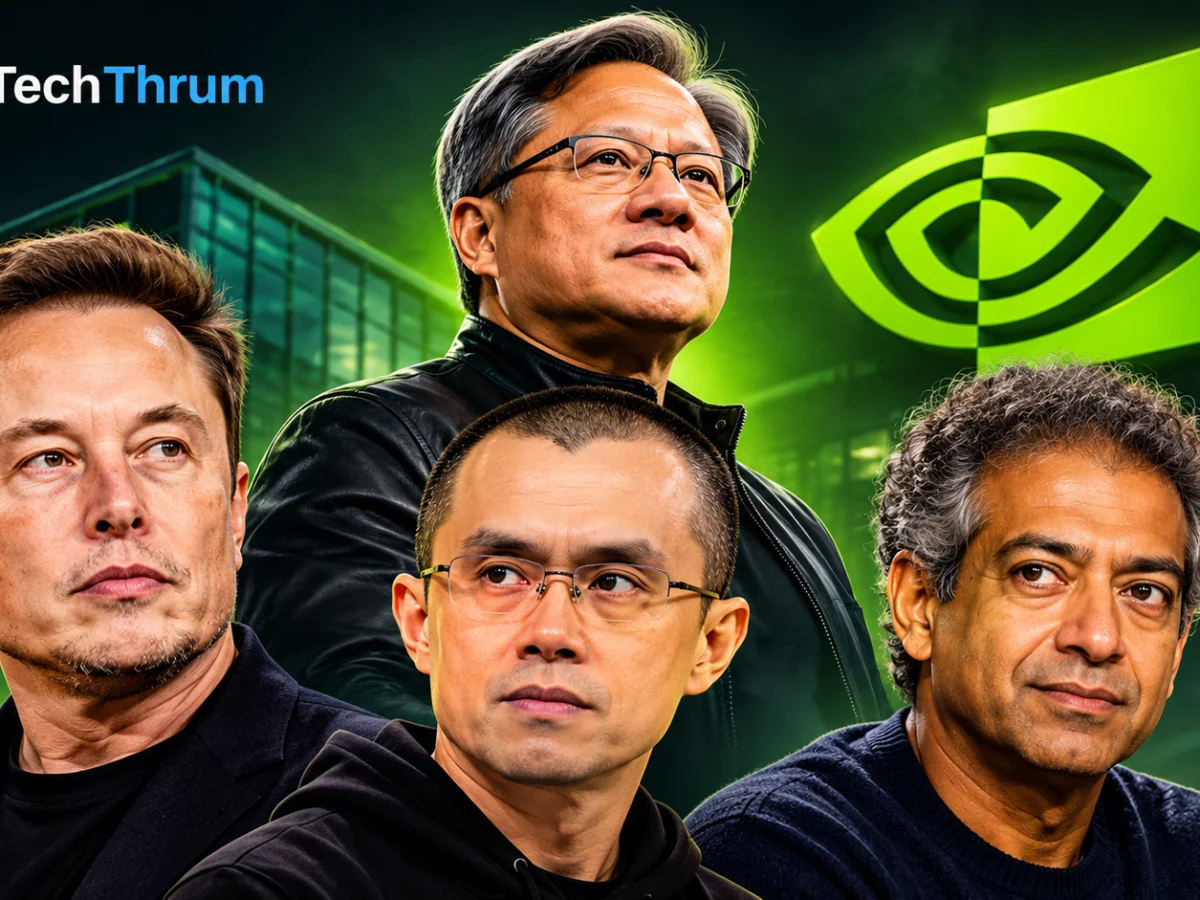
Among them are Tesla and SpaceX CEO Elon Musk, Binance co-founder Changpeng Zhao (CZ), investor Naval Ravikant, Epic Games CEO Tim Sweeney and Anduril founder Palmer Luckey.
Their reactions point to a much bigger conversation: how easily can a company replace the person who built its vision, culture and long-term strategy?
Why did Jensen Huang leave NVIDIA?
Huang’s departure followed a period of intense scrutiny surrounding reports of extramarital relationships, including one involving a woman suspected by US intelligence officials of having links to Chinese intelligence.
Nvidia’s board had announced an independent investigation into reports that Huang had been targeted by a foreign intelligence effort. In its November 8 statement, the company said it had no reason to believe that national security or Nvidia’s confidential information had been compromised.
On November 12, Nvidia announced that Huang had resigned as president, CEO and board member, effective immediately.
Colette Kress, the company’s longtime chief financial officer, was appointed interim CEO while the board began searching for a permanent replacement.
The circumstances have raised questions about corporate governance, executive accountability and whether the company moved too quickly to lose its most recognisable leader.
Elon Musk says he would sign a petition to bring Huang back
Elon Musk has emerged as one of the most visible voices supporting Huang.
Before the resignation, Musk agreed with Sequoia Capital partner Shaun Maguire, who argued that although Huang may have made serious personal mistakes, his contributions to American AI leadership made him difficult to replace.
Musk’s response was brief: “I agree.”
Following Huang’s resignation, Musk went further, announcing on X that he would sign a petition calling for Huang’s reinstatement at Nvidia.
He also responded to a user suggesting that he hire Huang, saying:
Musk’s comments reflect a broader belief among some technology founders that exceptional business leaders should not be easily discarded, particularly when they have spent decades building an organisation.
CZ: “It’s a mistake for Nvidia to let Jensen resign”
Changpeng Zhao, better known as CZ and the co-founder of Binance, was equally direct.
In a post on X on November 12, he wrote:
The statement quickly became one of the most widely discussed reactions to Huang’s departure.
CZ’s position reflects the view that the value of an exceptional founder goes beyond the company’s current financial performance. Founders often carry institutional knowledge, relationships, strategic instincts and a vision that can be difficult to transfer to a successor.
For a company operating at the centre of the global AI industry, losing that combination could be particularly consequential.
Naval Ravikant brings up Steve Jobs and Travis Kalanick
Investor and AngelList co-founder Naval Ravikant offered perhaps one of the most interesting perspectives.
Rather than directly criticising Nvidia’s board, Naval pointed to two well-known examples of founders being separated from the companies they built.
“You’d think we’d have learned from Steve Jobs and Travis Kalanick that one does not just simply replace the founder…”
The reference is significant.
Steve Jobs was famously removed from Apple in 1985, the company he co-founded. He eventually returned in 1997 and led one of the most remarkable corporate turnarounds in technology history.
Travis Kalanick, meanwhile, left Uber in 2017 following pressure from investors and other stakeholders. Unlike Jobs, he never returned to lead the company.
Naval’s point is that replacing a founder is not always as straightforward as appointing another capable executive. The person taking over may inherit the company, but not necessarily the instincts, ambition or vision that made it successful.
Read: Naval Ravikant’s post on X.
Tim Sweeney calls it a sad day for technology
Epic Games CEO Tim Sweeney also criticised Huang’s departure.
He described it as:
Sweeney credited Huang with building a company that achieved extraordinary scale while continuing to drive innovation.
He also highlighted Nvidia’s evolution across several technological generations, from gaming graphics cards to CUDA and AI supercomputers.
His reaction is particularly relevant because Nvidia’s influence extends far beyond its own products. Its GPUs and software ecosystem have become fundamental infrastructure for modern AI development, scientific computing and the wider technology industry.
More prominent figures are questioning the decision
The criticism has not been limited to Musk, CZ and Naval.
Several other prominent figures have also publicly supported Huang:
- Palmer Luckey, Anduril founder, wrote: “China wants Jensen out, so I want him in.” Read his post on X.
- Peter Steinberger, creator of OpenClaw, said Huang’s departure felt rushed and questioned whether it could destabilise one of America’s most successful companies. Read his post on X.
- Aravind Srinivas, Perplexity CEO, thanked Huang for 33 years of bold leadership, praising his perseverance and generosity towards other founders. Read his post on X.
- Lex Fridman, computer scientist and podcast host, said NVIDIA letting Huang go was terrible for America and publicly expressed his support. Read his post on X.
- David Heinemeier Hansson, co-founder of 37signals, called the development a waste and argued that there should be proportionality between personal misconduct and professional consequences. Read his post on X.
- Bill Ackman, billionaire investor, described Huang as an incredible human being who, like everyone else, can make mistakes. Read his post on X.
The reactions are not entirely uniform, but a common theme runs through many of them: Huang’s contribution to NVIDIA and the broader AI industry should not be overlooked.
The bigger question: Can Nvidia replace Jensen Huang?
Nvidia is not a typical technology company.
Under Huang’s leadership, it transformed from a graphics processing company into one of the most important infrastructure providers in the AI revolution.
Its GPUs power data centres, AI training systems, scientific research and the infrastructure behind some of the world’s largest AI companies.
More importantly, Huang was not simply the company’s public face. He was deeply associated with its long-term technical direction and its transition into accelerated computing.
That does not mean Nvidia cannot survive without him. The company has an experienced executive team, a substantial engineering organisation and a powerful ecosystem of developers and partners.
Colette Kress, who has served as CFO since 2013, now has the responsibility of maintaining continuity while the board searches for a permanent CEO.
However, maintaining operations and replacing a founder’s leadership are two very different challenges.
A successor may be capable of managing Nvidia’s existing business, but can that person maintain the same appetite for long-term bets, technological experimentation and strategic decisions that helped the company reach its current position?
That is the question investors and industry observers will be watching closely.
A lesson for founder-led companies
The Nvidia situation also brings back an important lesson from the histories of Apple, Uber and OpenAI.
Steve Jobs eventually returned to Apple. Sam Altman returned to OpenAI just days after being removed in 2023. Travis Kalanick, on the other hand, never returned to Uber.
These examples demonstrate that the relationship between founders, boards and shareholders can have consequences that extend far beyond an individual leadership change.
There is a legitimate reason for corporate boards to hold executives accountable. No founder should be considered untouchable, particularly when national security, employee welfare or corporate integrity may be involved.
But accountability also requires proportionality, sound evidence and careful decision-making.
For Nvidia, the immediate challenge is to prove that its future does not depend on one individual, even if that individual played an extraordinary role in building it.
Whether Huang eventually returns or moves on to another venture remains to be seen.
One thing is already clear: his departure has sparked a debate that reaches far beyond Nvidia’s boardroom.
And judging by the reactions from some of technology’s most influential founders and investors, many believe the company may have lost more than just its CEO.